
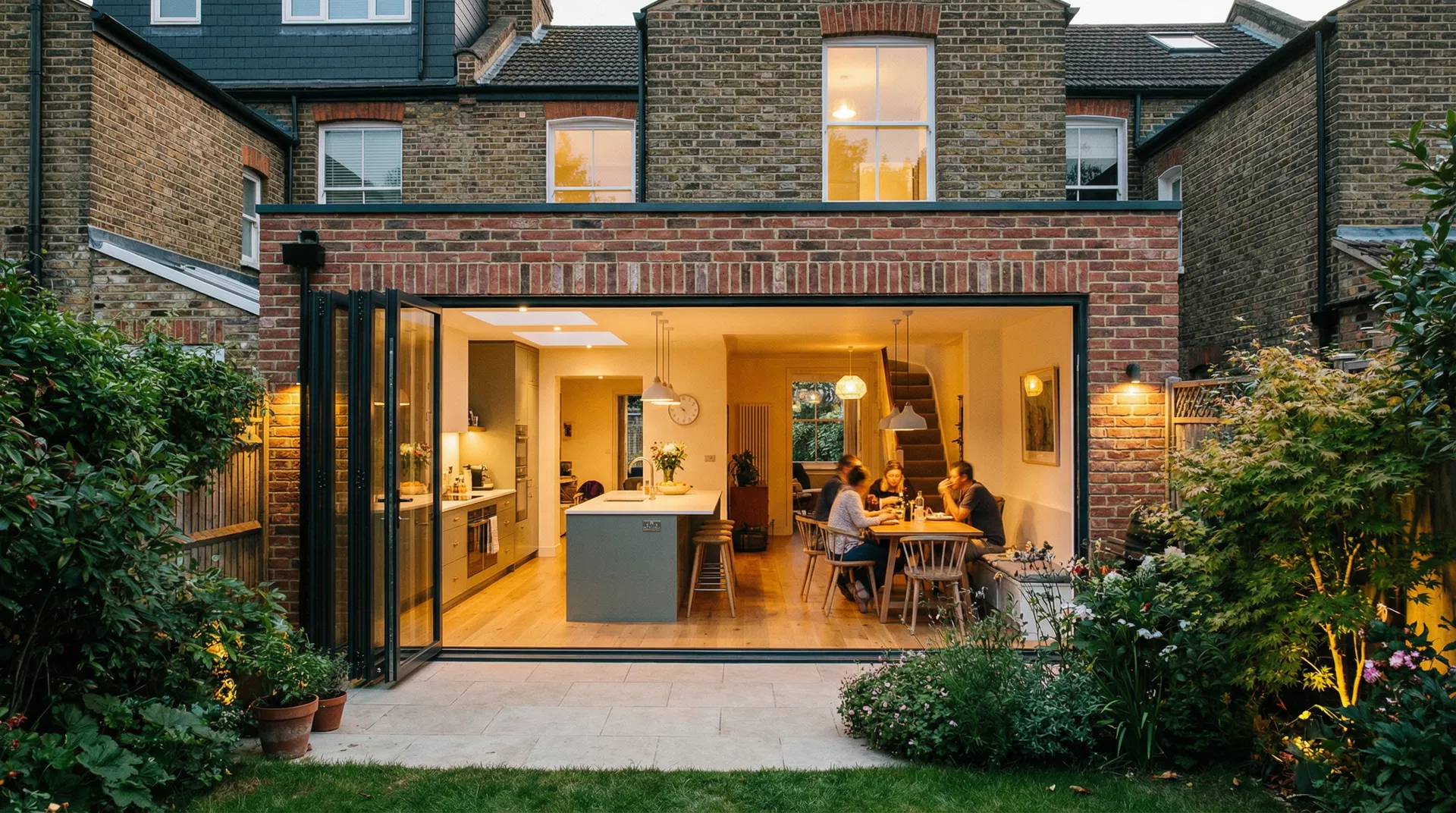
House Extension Mistakes to Avoid: 12 Costly Errors and How to Sidestep Them
Quick Answer
The most avoidable house extension mistakes fall into three categories: planning errors (wrong assumptions about permitted development, ignoring the Party Wall Act, missing underground services), contractor errors (choosing on price, skipping credential checks, signing vague contracts), and construction errors (shallow foundations on clay, poor roof junctions, inadequate insulation, missing building control sign-off). Every one of them is preventable before work starts.
Planning a house extension is one of the biggest decisions a homeowner makes. A single-storey rear extension in Hertfordshire typically costs between £38,000 and £80,000 in 2026 (BCIS Build Cost Index Q1 2026, 4.2% uplift applied) depending on size and specification, and the disruption to daily life is real. Most people get it right. But the ones who don't tend to make the same mistakes, and those mistakes are almost always avoidable.
At TCM Building & Maintenance, we've been called in to fix other builders' work more times than we'd like to count. We've also helped homeowners rescue projects that went wrong at the planning stage, long before a single brick was laid. The patterns are consistent. The same errors come up again and again, and they fall into three clear categories: planning mistakes, contractor mistakes, and construction mistakes.
This guide covers all twelve. If you're at the early stages of thinking about an extension, read this before you do anything else. If you're already mid-project and something feels off, this will help you identify what's going wrong and what to do about it.
Assuming You Don't Need Planning Permission
Permitted development rights allow many homeowners to extend without a full planning application, but the rules are more specific than most people realise. The limits depend on your property type, its location, whether it's in a conservation area, and whether an Article 4 Direction has removed PD rights in your area.
In parts of Hertfordshire — particularly within Hertsmere Borough Council's jurisdiction — and across several London Borough of Barnet sub-areas including parts of Finchley and Hendon, Article 4 Directions are in place that remove permitted development rights for certain types of work. Building without checking means you could be constructing an unauthorised structure, which becomes a serious problem when you sell.
The correct approach is to apply for a Lawful Development Certificate before starting any work. This gives you a formal record that your extension is lawful under PD. It costs around £206 and takes eight weeks, but it's the only document that protects you at the point of sale. The Permitted Development Rights Guide covers the limits by extension type and property category.
Underestimating What Planning Permission Actually Involves
When a full planning application is needed, homeowners often underestimate how long it takes and how much it costs. A standard householder application takes eight to ten weeks from submission to decision, but that clock doesn't start until the application is validated — and validation can take two to three weeks if drawings are missing or incorrect.
Add in the time to appoint an architect, produce drawings, and submit the application, and you're looking at four to six months from decision to start on site. Many homeowners budget for the build but not for the pre-application process, which typically costs £2,000–£5,000 in architect fees alone.
The House Extension Planning Permission Guide explains the full application process, including the difference between a householder application and a prior approval route, and when each applies.
Ignoring the Party Wall Act
If your extension is within three metres of a neighbour's property, or if it involves work on or adjacent to a shared boundary wall, the Party Wall etc. Act 1996 applies. You must serve a Party Wall Notice on your neighbour before work begins. Failing to do so doesn't just create a dispute — it can result in an injunction that stops your build entirely.
Party wall notices must be served at least two months before work starts for most types of extension work. If your neighbour dissents, a party wall surveyor is appointed to produce an Award — a legal document that governs how the work is carried out. TCM has an in-house party wall surveyor who manages this process for clients, which removes the risk of the process being handled incorrectly.
The most common surprise for first-time extending homeowners is discovering that a neighbour who seemed supportive verbally can still formally dissent once they receive a written notice. A formal dissent isn't necessarily hostile — it's often a neighbour protecting their own position — but it does add time and cost to the programme. Read the Party Wall Agreement Guide for a full explanation of the process.
Not Checking for Underground Services
Drainage, gas, electricity, and water mains run beneath gardens and driveways in patterns that aren't always obvious from the surface. Building over or near a public sewer requires consent from Thames Water or the relevant water authority. Building over a gas main requires a separate approval process.
Discovering an uncharted drain or a gas main during groundworks is one of the most common causes of cost overruns on extension projects. A proper pre-start survey — including a drainage CCTV survey and a utility search — costs a few hundred pounds and can save tens of thousands. Our Foundations & Groundworks team carries out utility checks as standard before any groundworks begin.
Choosing on Price Alone
The cheapest quote is almost never the right quote. When a builder's price is significantly lower than others, one of three things is usually true: they've missed something in the specification, they're planning to use cheaper materials or subcontractors, or they're buying the job with the intention of raising the price once work has started.
At TCM, we see the consequences of this regularly. We're called in to complete or remediate extensions where the original contractor has walked off site, gone into administration, or produced work that fails building control inspection. The cost of putting it right is almost always higher than the difference between the cheapest and the correct quote would have been.
When comparing quotes, compare like for like. Ask each builder to provide a full specification breakdown — materials, build method, drainage details, insulation specification — not just a total price. The How to Choose a Builder guide includes a checklist for testing any builder's contract and a red flags vs green flags table.
Not Checking Credentials and Insurance
A builder's credentials matter more on an extension than on smaller jobs. Extensions involve structural work, building regulations compliance, and significant financial exposure. The minimum you should verify before signing a contract:
- Public liability insurance (minimum £2 million, ideally £5 million)
- Employers' liability insurance (legally required if they employ staff)
- Checkatrade or equivalent third-party verification
- Evidence of previous similar projects with references you can actually call
IPAF certification matters if the job involves working at height. Gas Safe registration is required for any gas work. NICEIC or Part P certification is required for electrical installation. These aren't optional extras — they're the minimum standard for a contractor working on your home.
TCM holds Checkatrade verification, IPAF certification, and Waste Carrier registration, and all electrical and gas work is carried out by registered specialists. Verifying these credentials takes ten minutes and protects you from the most common contractor risk.
Signing a Vague Contract
A contract that says "build a rear extension for £45,000" is not a contract. It's an invitation to a dispute. A proper building contract specifies the scope of work in detail, the payment schedule, the programme (start date, milestone dates, completion date), the process for variations, and the retention arrangement.
Stage payments are standard on extension projects. A typical structure is: deposit on contract signing (10–15%), payment at completion of foundations, payment at completion of structure, payment at completion of first fix, payment at completion of second fix, and a final payment on completion with a retention held for three to six months. Any contract that asks for more than 20–25% upfront before work starts is a warning sign.
Retention — typically 2.5–5% of the contract value held back for three to six months after completion — protects you against defects that emerge after handover. A builder who refuses to accept a retention clause is a builder who is not confident in their own work.
Inadequate Foundations for the Soil Type
Most of Hertfordshire sits on London Clay, a shrinkable clay subsoil that expands when wet and contracts when dry. Extensions built on strip foundations that are too shallow for clay subsoil will move seasonally, causing cracking in walls, doors that stick, and — in serious cases — structural failure.
Building Regulations require foundations to be taken down to a depth where the soil is stable and unaffected by seasonal moisture change. On London Clay, this typically means a minimum depth of 1.0–1.2 metres, and sometimes deeper where there are trees nearby. Tree roots extract moisture from clay, increasing the seasonal movement range.
We've been called in to underpin extensions in Borehamwood, Radlett, and Watford where the original foundations were poured at 450mm — a depth that might be adequate on chalk or gravel but is completely insufficient on clay. Underpinning an existing extension is expensive, disruptive, and entirely avoidable if the foundations are specified correctly from the start. The Structural Repairs page explains the relationship between foundation depth, soil type, and structural movement.
Getting the Roof Junction Wrong
Where a new extension roof meets the existing house wall, the junction must be correctly detailed and waterproofed. This is one of the most common sources of water ingress on extensions, and it's almost always a workmanship issue rather than a design issue.
The correct approach depends on the roof type. A flat roof extension requires a proper upstand — typically 150mm minimum — where the flat roof membrane turns up against the house wall, with lead or GRP flashing dressed into the masonry above. A pitched roof extension requires the roof tiles to be cut and pointed correctly at the abutment, with lead soakers and a stepped flashing.
Shortcuts at this junction — using mastic sealant instead of lead flashing, or failing to form a proper upstand on a flat roof — will fail within two to five years. The water ingress that results causes damage to internal finishes, insulation, and in some cases the structural timber. Our Roofing Services team works alongside every extension build to ensure roof junctions are detailed and executed correctly.
Underinsulating the New Structure
Building Regulations Part L sets minimum thermal performance standards for new extensions. The current requirements (post-2022 Part L update) are more demanding than they were five years ago, and extensions that don't meet them will fail building control inspection.
But the more common problem isn't failing inspection — it's passing inspection with the minimum specification and then living with an extension that's cold in winter and hot in summer because the insulation is technically compliant but practically inadequate.
The minimum U-value for an external wall under current Part L is 0.18 W/m²K. Achieving this with a standard cavity wall requires 100mm of full-fill cavity insulation. Many builders use 50mm partial-fill insulation, which achieves around 0.28 W/m²K — compliant under older regulations, but not under the current standard, and noticeably worse in performance. Specifying the correct insulation at design stage adds very little to the build cost. The Energy-Efficient Extensions guide covers the fabric specifications that make the biggest difference to running costs.
Skipping the Damp Proofing Detail at the Base of the Extension
Every external wall in a new extension must have a damp proof course (DPC) at a minimum of 150mm above external ground level, with a continuous damp proof membrane (DPM) in the floor slab that laps up to meet the DPC in the wall. This creates a continuous barrier against rising damp.
The detail fails when the DPC is omitted, when it's installed at the wrong height, or when the lap between the floor DPM and the wall DPC is not formed correctly. The consequences take two to three years to appear — by which time the internal finishes are damaged and the structural timber is at risk.
In Hertfordshire's older housing stock, we regularly see extensions where the DPC detail was either not formed at all or was formed incorrectly. The Damp Proofing & Waterproofing page explains the diagnosis pattern and the remediation options, including when a chemical DPC injection is appropriate and when physical remediation is required.
Not Getting Building Control Sign-Off
Building control approval is not optional. It's a legal requirement for extensions, and the completion certificate issued at the end of the process is the document that proves the work was carried out to the required standard. Without it, you cannot sell the property — or at least, you cannot sell it without disclosing the absence of the certificate, which will affect your sale price and your ability to find a buyer.
Building control sign-off requires inspections at key stages: commencement, foundations, damp proof course, structural frame, insulation, and completion. Missing an inspection means the inspector cannot certify that stage of the work, which can require opening up completed work for retrospective inspection.
The Building Regulations for Extensions guide covers the full inspection schedule and what building control inspectors look for at each stage.
From Our Work
What We're Actually Called In to Fix
The mistakes above aren't theoretical. They're drawn from 63 projects we've completed or remediated across Hertfordshire and North London since 2020.
The most common call-out is water ingress at the roof junction — typically a flat roof extension where the upstand wasn't formed correctly and the junction was sealed with mastic rather than lead flashing. By the time we're called in, the damage has usually spread to the ceiling joists and the internal plasterboard. The repair cost is typically £3,500–£9,000 (2026 rates), compared with a correct installation cost of £450–£900. See our flat roof systems guide for the specification details that prevent this.
The second most common is foundation movement on clay subsoil. We've underpinned extensions in Borehamwood, Radlett, and Watford where the original foundations were poured at 450mm on London Clay. The cracking pattern is distinctive — diagonal cracks from the corners of window and door openings — and the remediation involves excavating alongside the existing foundation and forming a new, deeper footing in sections. Cost: £9,000–£28,000 (2026 rates) depending on the extent of movement.
The third is the absence of a building control completion certificate. This comes up at the point of sale, usually years after the extension was built. The options are limited: apply for a regularisation certificate (which requires opening up the structure for inspection), obtain indemnity insurance (which covers the buyer but not the underlying defect), or reduce the sale price to reflect the risk. None of these is a good outcome.
Getting these details right at the start costs nothing extra. Getting them wrong costs a great deal.
Pre-Start Checklist: What Should Be in Place Before Work Begins
| Check | What to Verify | Status |
|---|---|---|
| Planning status | PD certificate or planning permission granted and conditions discharged | |
| Party wall | Notices served and any Awards agreed before start on site | |
| Utilities | Drainage CCTV survey and utility search completed | |
| Contract | Scope, specification, payment schedule, retention, and programme all in writing | |
| Credentials | Insurance, accreditations, and references verified | |
| Building control | Building notice or full plans application submitted and acknowledged | |
| Foundation design | Soil investigation completed; foundation depth specified by structural engineer | |
| Roof junction | Detailed drawing showing upstand, flashing, and waterproofing specification | |
| Insulation | U-values specified and confirmed to meet current Part L requirements | |
| DPC/DPM | Continuous barrier specified at correct height with confirmed lap detail |
Frequently Asked Questions
Related Services & Guides
House Extension Services
Full-service extensions across Hertfordshire and North London
House Extension Cost Guide 2026
Verified 2026 cost data for single-storey, double-storey, and wrap-around extensions
Extension Planning Permission Guide
When you need planning permission and how to apply
Permitted Development Rights
What you can build without a planning application
Party Wall Agreement Guide
When notices must be served and what happens if a neighbour dissents
Building Regulations Guide
The inspection schedule and what building control checks at each stage
How to Choose a Builder
A checklist for evaluating contractors and their contracts
Loft Conversion vs House Extension
Which adds more value and which is right for your property?
Structural Repairs
Foundation movement, cracking, and structural defects
Damp Proofing & Waterproofing
Diagnosis and treatment for damp in extensions
Start Your Extension the Right Way
TCM handles house extensions across Hertfordshire and North London — planning, party wall, structural engineering, and building control under a single point of contact. Get a free site survey and fixed-price quote before any commitment is made.
Or read the How to Plan a House Extension guide to understand every stage from initial idea to start on site.